
Website vs Social Media: Why a Facebook Page Isn’t Enough for Your Small Business

By Nathanael Auran | July 28, 2026 | Running the Business, Strategy | Reading Time: 11 minutes
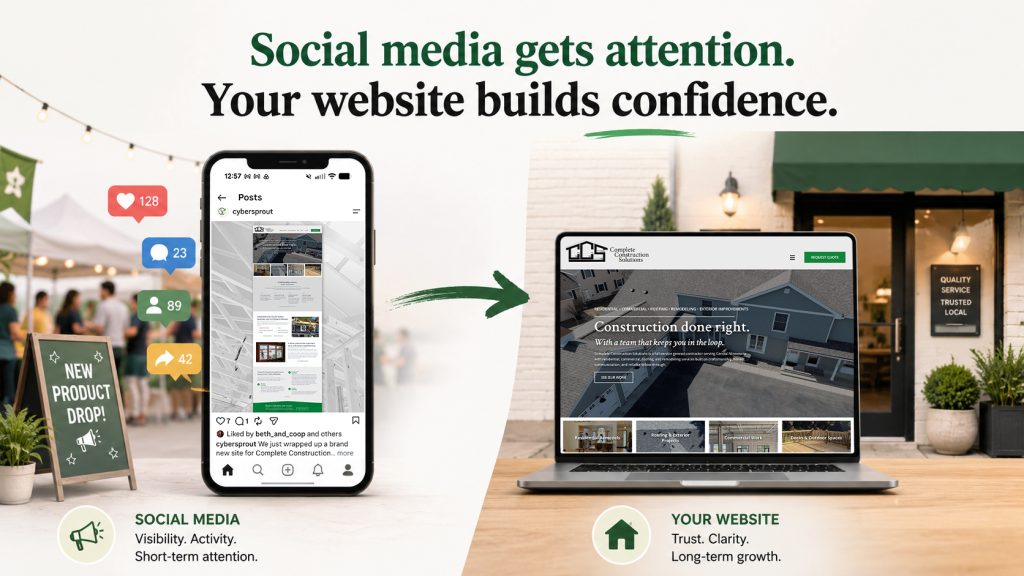
If you’re comparing website vs social media for your business, here’s the quick answer: social media is helpful, but it should not be the only place your business lives online.
A Facebook page, Instagram profile, or LinkedIn account can help people discover your business, follow your updates, and interact with your brand. That’s valuable. But your website does a different job. It gives your business a central, searchable, trustworthy place to explain what you do, answer common questions, show proof, and guide people toward the next step.
In other words: social media helps people notice you. Your website helps people trust you.
Table of Contents
The Quick Answer: You Probably Need Both
For most small businesses, the answer is not choosing a website vs social media for your business. It’s both.
“Social media helps people notice you. Your website helps people trust you.”
Social media is like setting up a booth at a busy community event. You can meet people, share updates, have conversations, and stay visible. Your website is more like your actual storefront or office. It is the place people go when they want to understand who you are, what you offer, whether they trust you, and how to take action.
That action might be calling, booking, requesting a quote, donating, buying, signing up, or visiting your physical location.
A Facebook page and other social media profiles can support your business, but they should not replace your website.
What Social Media Does Well
Let’s give social media the credit it deserves. It can be a great tool for small businesses.
Social media is useful for:
- Sharing quick updates
- Posting photos, videos, and behind-the-scenes content
- Promoting events, sales, specials, or announcements
- Staying visible with current customers
- Building community and conversation
- Sending traffic back to your website
- Helping people get a feel for your personality
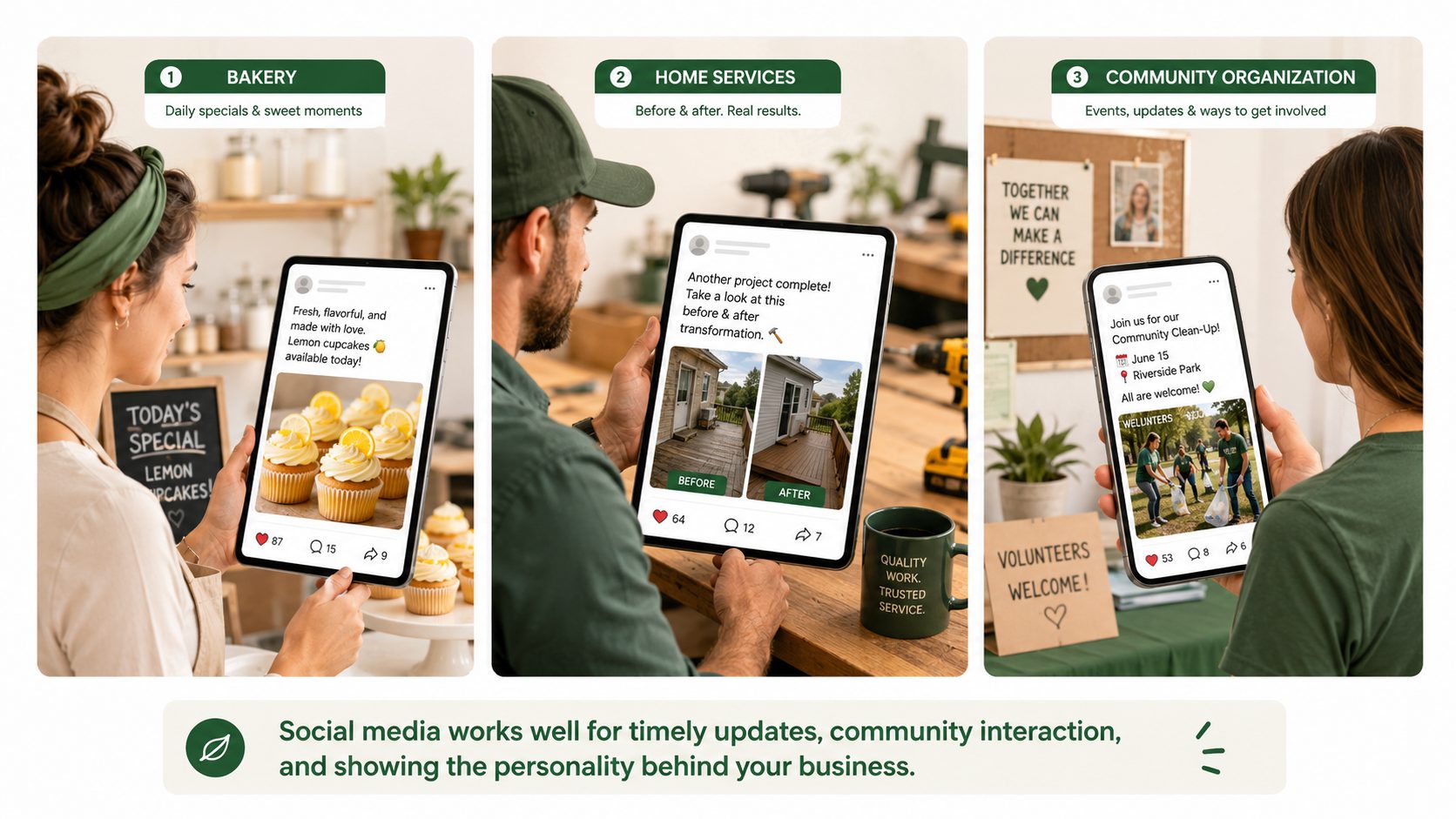
Social media works well for timely updates, community interaction, and showing the personality behind your business.
Facebook is also still widely used. Pew Research Center reported that 71% of U.S. adults said they use Facebook, while 84% said they use YouTube. So yes, social media still matters.
For example, a bakery might use Facebook to share today’s cupcake flavors. A contractor might post before-and-after photos. A nonprofit might share event reminders and volunteer opportunities.
That kind of content is great for keeping people engaged.
But here’s the catch: social media is not always great at helping someone make a confident buying decision.
Where Social Media Falls Short
One of the biggest misconceptions we hear from small business owners is some version of, “Everyone has Facebook (or other social media accounts), so that should be enough.”
But not everyone uses Facebook, or other social media for that matter. And even if they do, they may not be logged in when they are searching. They may not want to scroll through posts to find your hours, services, pricing details, service area, or contact information.
When small businesses rely only on social media, we often see a few common problems.
- The business has limited control. You do not own Facebook, Instagram, TikTok, LinkedIn, or any other social platform. You are building on someone else’s land. If the platform changes how posts are shown, limits your reach, locks your account, removes content, or changes business page features, your business has to react. Meta even has support processes for page policy issues and appeals, which is a good reminder that business pages are subject to platform rules and restrictions.
- The content is limited and harder to organize. Social media is built around posts and feeds. That works well for updates, but it is not ideal for presenting detailed service pages, FAQs, team information, customer testimonials, awards, process details, and clear calls to action.
- Social media does not give you the same analytics picture as a website. You may see likes, comments, shares, or views, but you will not get the same level of insight into how people move through your content, which pages matter most, or where visitors drop off before contacting you.
- A social-only presence can hurt credibility. It may not be fair, but people make quick judgments online. If a potential customer searches for your business and only finds a Facebook page, they may wonder how established, professional, or active your business really is.
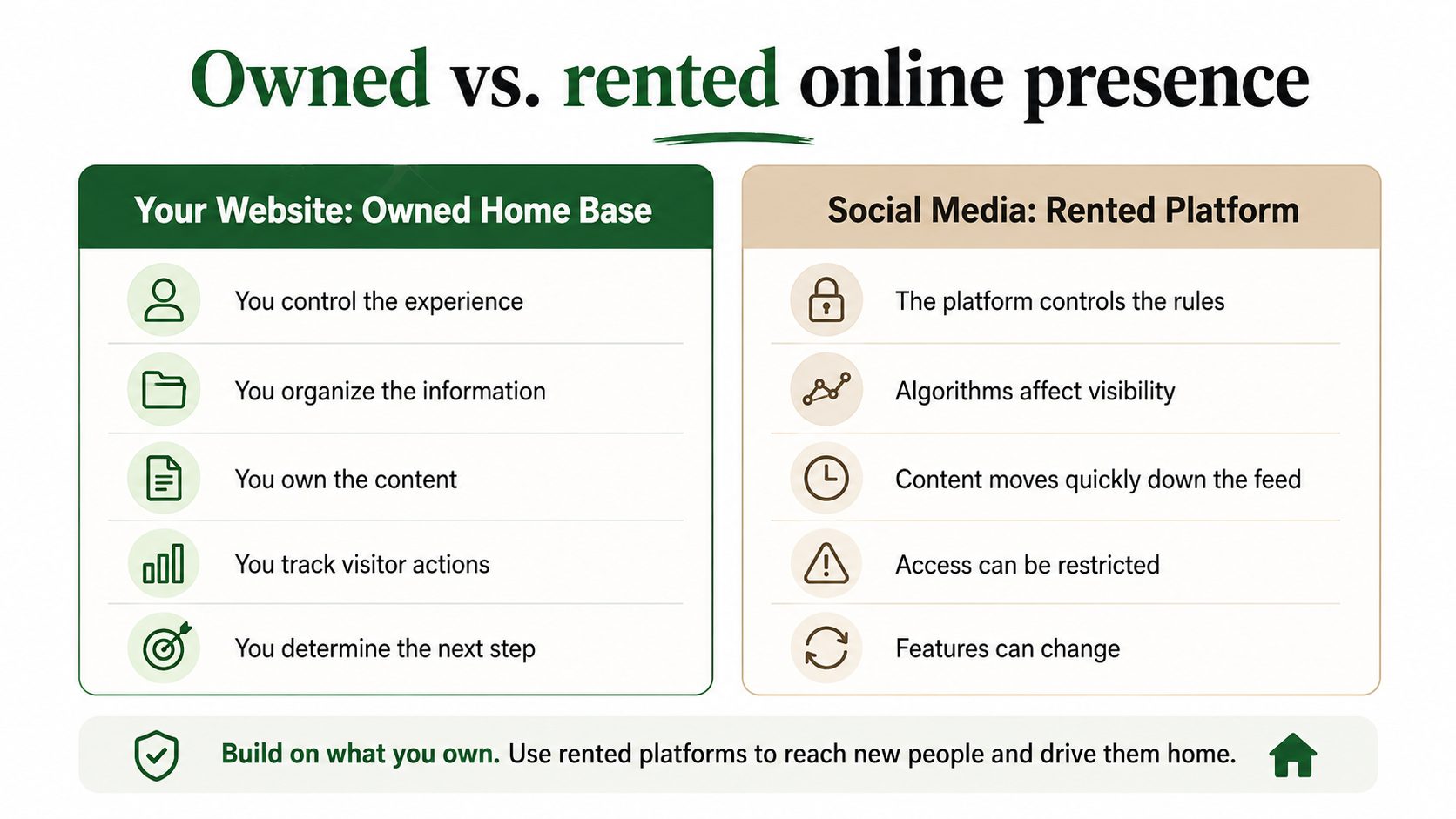
That matters even more when they are comparing you to another business with a clear, helpful website.
What a Website Does That Social Media Can’t
A small business website gives you a place to control your message.
You decide what visitors see first. You choose how your services are explained. You organize information in a way that helps people quickly understand whether you are the right fit.
At CYBERsprout, we often talk about a website as a business’s “digital lobby.” Before someone calls, emails, books, or visits, they often check you out online. Your website is part of that first impression.
“A good website is not just a digital business card. It is a tireless employee working for your business 24/7.”
A dated, confusing, broken, or missing website can feel like a storefront with peeling paint and a locked door. A clear, modern website can help people feel like, “Okay, this business is real. They know what they’re doing. I know what to do next.”
That is one of the biggest business website benefits: it helps remove uncertainty.
A Website Helps People Find You in Search
One of the strongest reasons why small businesses need a website vs social media is search visibility.
A Facebook page may show up in Google, but it usually cannot do everything a website can do. Your website can include dedicated pages for your services, products, locations, team, FAQs, industries served, testimonials, and more.
That matters because search engines need clear content to understand what your business does. Google’s SEO Starter Guide explains that SEO is about helping search engines understand your content and helping users decide whether they should visit your site.
For local businesses, a website can also support structured information about your business. Google’s LocalBusiness structured data guidance explains that business websites can provide details such as business hours, departments, and reviews when applicable.
That does not mean a website magically guarantees rankings. It doesn’t. But it gives your business a stronger foundation than social media alone.
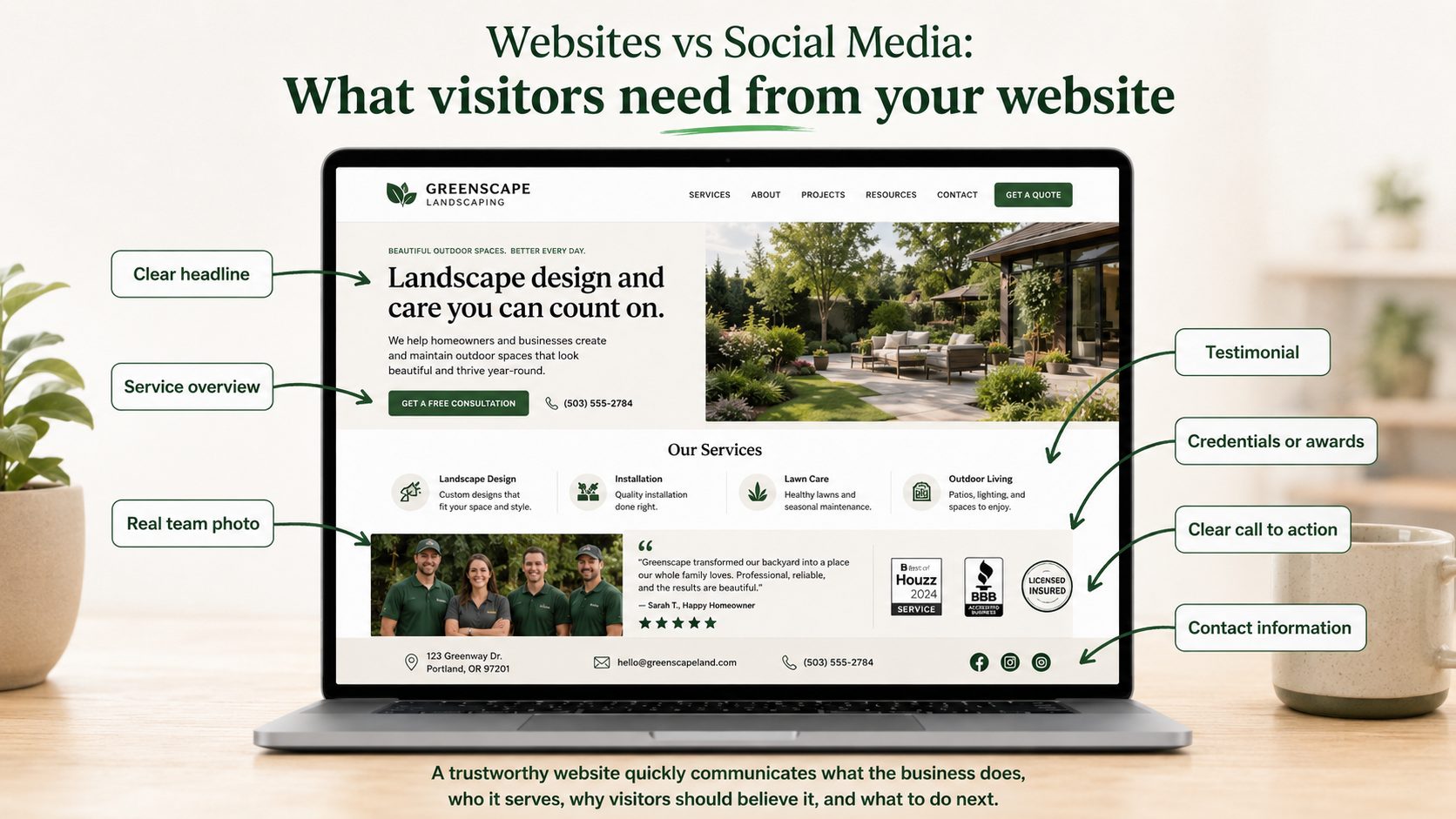
A trustworthy website quickly communicates what the business does, who it serves, why visitors should believe it, and what to do next.
A Website Builds Trust Faster
People are skeptical online. That is especially true when they are spending money, hiring a service provider, planning a project, or choosing a local business.
A helpful website can build trust by including the right kinds of social proof, which are the signals that show real people have worked with you, bought from you, trusted you, or recommended you:
- Clear information about what you do and who you serve
- Detailed service or product pages
- Customer testimonials and reviews
- Awards, certifications, affiliations, or credentials
- Real photos of your team, work, location, or process
- A transparent About page
- FAQs that answer common concerns
- Clear contact information
- Simple calls to action
We’ve shared more examples in our article on why social proof matters for your website.
One piece of advice we give small business owners often: your website should explain what you do and who you do it for in three seconds or less.
Visitors should not have to work hard to understand your business. They should land on your site and quickly think, “Yes, I’m in the right place.”
Reviews are one of the clearest ways to build trust before someone contacts you. They can support your Google Business Profile, improve the way your business appears in local search, and give visitors more confidence once they land on your website. For more on that, read our guide on how to get Google Reviews for Local SEO success.
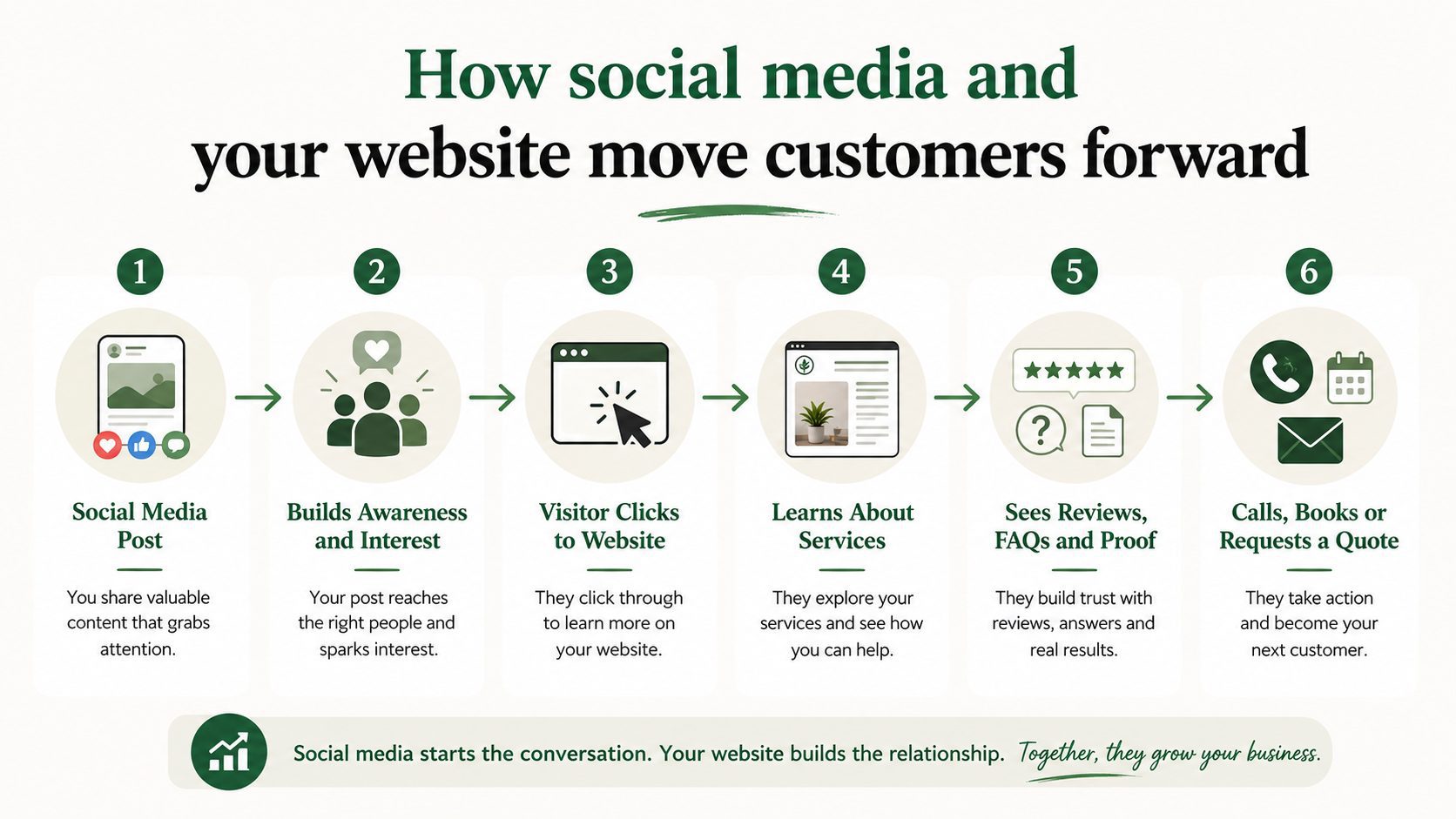
A Website Turns Interest Into Action
Social media can create interest. Your website should turn that interest into action.
That might mean:
- Requesting a quote
- Booking a consultation
- Calling your office
- Placing an order
- Making a donation
- Joining an email list
- Downloading a guide
- Filling out a contact form
- Visiting your location
This is where the website vs social media for small business conversation becomes clearer.
Social media is great for starting the relationship. A website is better for guiding the relationship forward.
On your website, you control the storyline. You can lead visitors from a service page to a testimonial, from a testimonial to an FAQ, and from an FAQ to a quote request. You can also track those actions through tools like Google Analytics, which gives you better insight into what is working.
Website vs Social Media: A Simple Comparison
| Category | Website | Social Media | Best Use |
|---|---|---|---|
| Ownership | You control the platform, content, structure, and design | You rely on a third-party platform | Website |
| Visibility | Supports SEO, local search, and long-term content | Helps with reach, awareness, and engagement | Both |
| Credibility | Builds a more professional first impression | Can show activity and personality | Website |
| Content Depth | Great for detailed services, FAQs, proof, and process | Better for quick updates and short-form content | Website |
| Engagement | Can include forms, lead magnets, and conversion paths | Better for comments, shares, and conversations | Social media |
| Analytics | Better insight into visitor behavior and conversions | Helpful but often platform-limited | Website |
| Risk | You own more of the experience | Platform rules, algorithms, and access can change | Website |
| Conversion | Built to guide visitors toward action | Often better at starting awareness | Website |
The simplest way to think about it is this:
Social media is best for staying visible. A website is best for being found, trusted, and contacted.
Is a Facebook Page Enough for a Business?
It can be, but usually only for a short time.
A Facebook page and other social media profiles might be enough if you are testing a small idea, selling casually, running a short-term event, or building early awareness before launching something more official.
But if you are serious about growing, attracting better leads, showing up in search, or looking more professional, these social media profiles or pages alone will eventually hold you back.
We sometimes hear business owners say:
- “My brother set up our Facebook page, and it’s free.”
- “Everyone has Facebook.”
- “Websites are expensive.”
- “I’ll build a website when we’ve grown more.”
Those concerns are understandable. But a website should not be viewed only as a cost. It is a business asset.
If cost is the thing holding you back, it may help to look at what a professional small business website actually includes. We break that down in more detail in our article on small business website cost, including why pricing can vary so much based on content, strategy, design, development, SEO setup, and long-term goals.
A good website works even when you are not available. It answers questions, builds trust, explains your value, and helps visitors take the next step. In that sense, your website can act like a tireless employee working 24/7.
Signs It’s Time to Build a Website
You may be ready for a website if:
- People keep asking the same basic questions
- You want to show up better in Google
- You are sending people to Facebook, but they are not taking action
- You want your business to look more established
- You need quote forms, booking, online payments, donations, or ecommerce
- You want to explain services in more detail
- You want better analytics and conversion tracking
- You are investing in marketing and need a stronger place to send traffic
- You want to reduce the amount of time spent answering repetitive questions
Checking several boxes on this list?
You may not need a huge website. You may just need a clearer one. Let’s talk about what your customers need now and what your business may need as it grows.
The good news? Your first website does not need to be huge.
The goal is not to build the biggest website possible. The goal is to build the clearest one your customers need right now.
For many small businesses, the right starting point is a simple, clear website that explains who you are, what you offer, who you help, why people should trust you, and how to contact you.
Not sure whether to start with a DIY website or bring in professional help? That usually comes down to your budget, your comfort with technology, and how much your business depends on the website for leads, sales, or credibility. We walk through that decision in more detail in Should You Build Your Own Website or Hire a Pro?
What Should Be On a Starter Small Business Website?
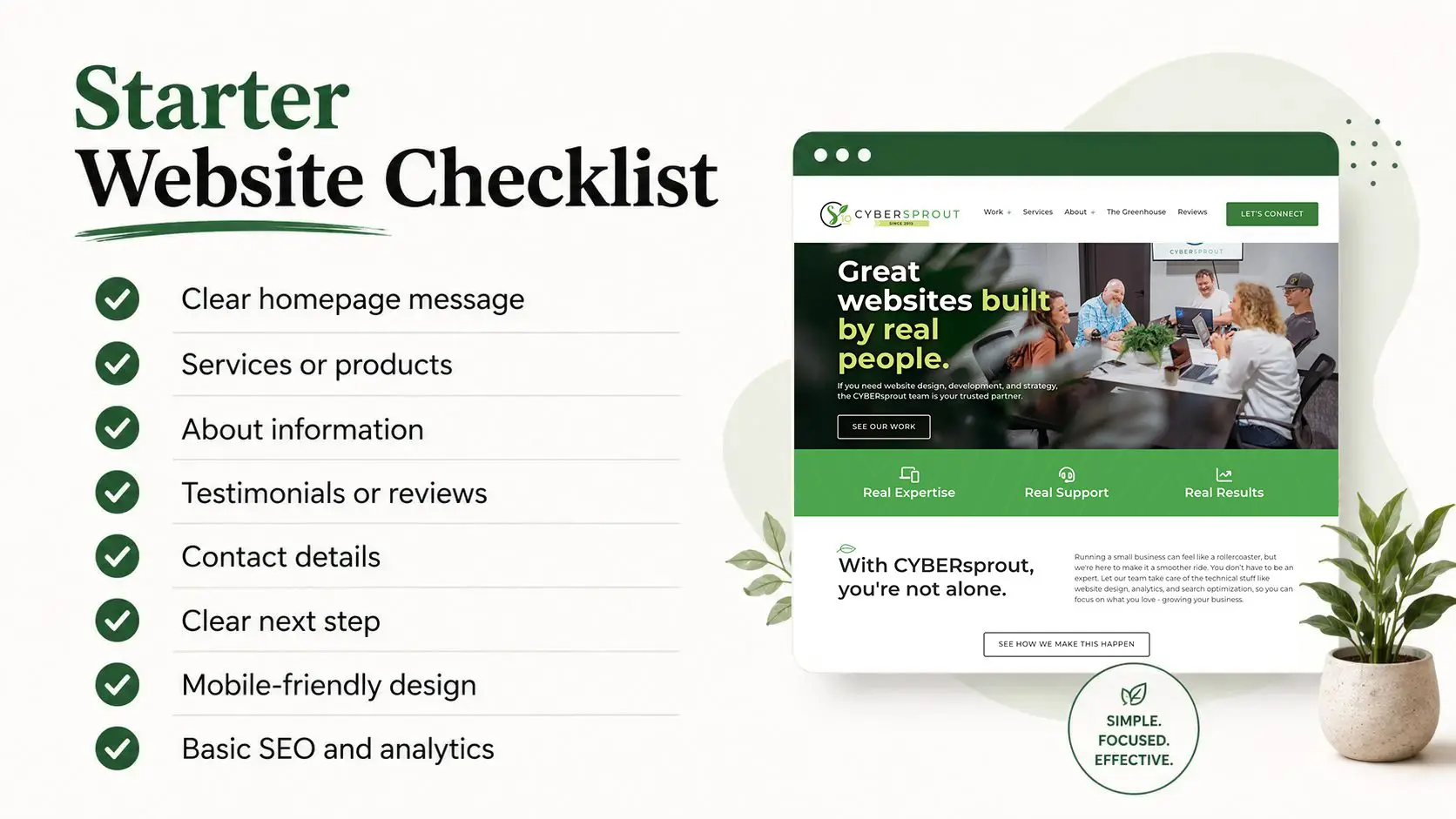
A starter website should be easy to use, easy to understand, and built around the questions your customers already have.
At minimum, consider including:
- A homepage with a clear message
- Service or product information
- Contact information
- Location or service area details
- About section or About page
- Customer testimonials or reviews
- FAQs
- Photos that feel real and trustworthy
- Clear calls to action
- Basic SEO setup
- Google Analytics or other tracking
- Links to your social media profiles
The goal is not to overwhelm people. The goal is to help them feel confident.
Platform choice matters too. For many small businesses, WordPress is a strong fit because it gives you room to start simple and grow over time. If you’re weighing platform options, our article Is WordPress Right for Your Small Business Website? explains when WordPress makes sense and when another option may be a better fit.
People want to know what you do, whether you serve someone like them, whether you are trustworthy, and what they should do next.
What About Google Business Profile?
Google Business Profile is important, especially for local businesses. It can help people find your business in Google Search and Maps.
But it should not fully replace your website.
Your Google Business Profile can show helpful details like your hours, reviews, photos, and location. Your website gives you room to explain your services, answer questions, share your story, show proof, and guide visitors toward a next step.
Think of Google Business Profile as an important doorway. Your website is the place people should be able to walk into once they find you.
This matters even more as online discovery changes. BrightLocal’s 2026 local consumer research notes that AI tools are becoming part of how people find local business recommendations, with 45% of consumers using AI tools for local business recommendations.
The clearer and more trustworthy your online presence is, the easier it is for both people and search tools to understand your business.
Your Google Business Profile is an important part of being found locally, but it works best when it is connected to a clear, trustworthy website. If you want a deeper breakdown of how local visibility works, our guide to Local SEO for small businesses explains how Google uses proximity, relevance, and prominence to decide which businesses show up in local results.
How Your Website and Social Media Should Work Together
When it comes to website vs social media, neither of them should compete with each other. They should support each other.
Use social media to:
- Share updates
- Promote new blog posts or service pages
- Highlight customer stories
- Show behind-the-scenes content
- Build personality and connection
- Remind people about events, specials, or seasonal services
- Send people to useful pages on your website
Use your website to:
- Explain your services clearly
- Answer common questions
- Show proof and credibility
- Capture leads
- Track visitor behavior
- Help people contact, book, buy, or request information
- House content that stays useful over time
For example, a blog article answering “How much does a small business website cost?” can become several social posts, an email newsletter topic, a sales conversation resource, and an SEO asset.
That is when your marketing starts working together instead of living in separate buckets.
The Bottom Line: Social Media Builds Attention, Your Website Builds Confidence
Social media is valuable. A Facebook page and other social media profiles can absolutely help your business stay visible and connected.
But when it comes to website vs social media, your website plays a bigger role in trust, search visibility, and conversions.
A Facebook page and other social media profiles alone can limit your control, weaken your search presence, reduce your credibility, and make it harder for people to find the information they need. A website gives your business a professional home base where you can tell your story, guide the visitor, and make the next step clear.
So, do I need a website for my business if I already have social media?
For most serious small businesses, yes.
You may not need a huge website right away. But you do need a clear, trustworthy place that you own. One that helps people understand what you do, why they should trust you, and how to start working with you.
Because your first impression should feel as professional as the work you do.
Wondering whether your current online presence is helping people trust you — or leaving them with questions?
We’d be happy to take a look and help you identify a few easy wins.
References and Further Reading
- Pew Research Center: Americans’ Social Media Use 2025 — Useful for understanding how widely platforms like Facebook and YouTube are used by U.S. adults.
- Google Search Central: SEO Starter Guide — Helpful overview of how SEO helps search engines understand website content and helps users decide whether to visit a site.
- Google Search Central: Local Business Structured Data — Explains how business websites can provide structured information such as hours, departments, and other local business details.
- U.S. Small Business Administration: Social Media Marketing — Frames social media as one part of a broader online presence that can include a website and email marketing.
- Mailchimp: Why Social Is Not a Substitute for a Website — A beginner-friendly explanation of how social media supports visibility while websites help build relationships and conversions.
- BrightLocal: Nearly Half of Consumers are Asking AI for Business Recommendations — Helpful context on how AI tools are becoming part of local business discovery.
- Meta Business Help Center: How to Submit an Appeal If Your Creator Content, Page or Group Is Taken Down — Useful reminder that business pages operate under platform rules and appeal processes.

