
Why Your Business Still Needs a Human Designer in the Age of AI

By Beth Leipholtz | June 3, 2026 | Design | Reading Time: 3 minutes

AI website builders have come a long way in a few short years. Answer a few questions, click some buttons, and you’ve got a complete website — images, text, and links included.
For some projects, that might be enough.
But if your website is one of your most important business assets (spoiler: it should be), there’s a real difference between a website that simply exists and one that actually works.
Here are five reasons a human designer still makes all the difference.
Table of Contents
AI can build a website. It can’t build a strategy.
Most AI website builders start the same way: a handful of questions about your industry, your services, and a few basic details.
The result is a site that looks fine, but probably won’t do much to turn visitors into customers.
A human designer asks things AI won’t think to ask:
- What makes your business different from competitors?
- What concerns do customers have before reaching out?
- Which services are most profitable?
- What do customers need to know before they’re ready to buy?
- What should each page actually accomplish?
- What concerns do customers have before reaching out?
A website should be built around your business objectives rather than assembled from a template and a few generic prompts.
Your customers aren’t cookie-cutter so your website shouldn’t be either.
AI creates content based on patterns. Human designers create experiences based on people.
A few examples:
- A local HVAC company in Minnesota has different customers, concerns, and buying behaviors than one in Florida.
- A boutique retailer serves customers very differently than a national chain.
- A nonprofit has different goals than a law firm.
Human designers take time to understand your audience, your market, and your community. What they learn from you shapes everything — from page structure and messaging to calls-to-action and navigation.
Good design is more than a pretty page.
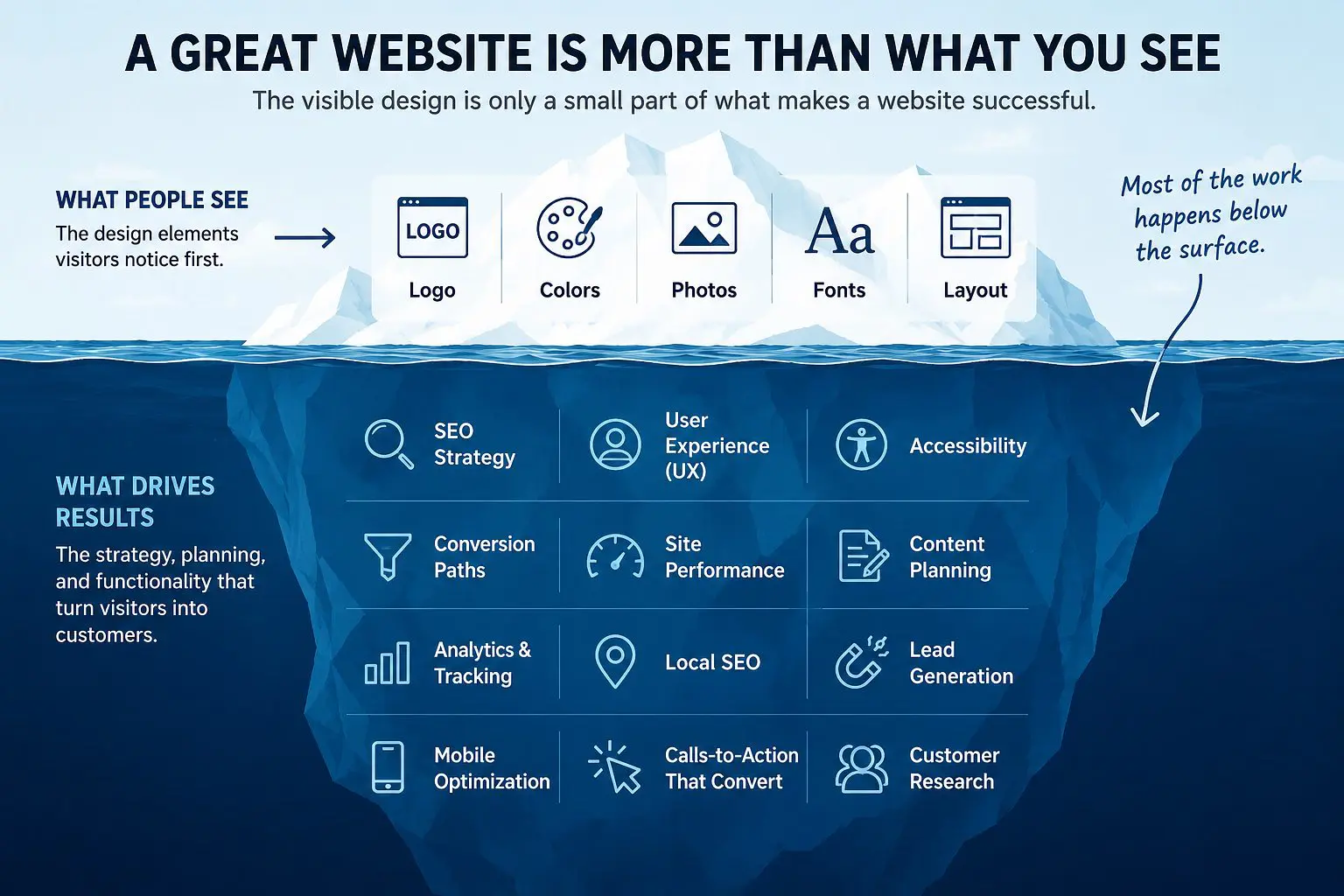
A polished site and a purposeful site aren’t the same thing. AI can handle the visuals. What it tends to miss is everything working underneath them.
An experienced human designer considers:
- User behavior and conversion paths
- Mobile usability and accessibility
- Search engine optimization
- Site performance
- Lead generation opportunities
These decisions are often invisible to visitors, but they have a major impact on whether a website generates leads and helps a business grow.
SEO still requires human expertise.
AI can generate content quickly, but effective SEO requires an ongoing strategy.
Successful websites are built around:
- Keyword research
- Competitive analysis
- Local search optimization
- Technical SEO
- Content planning
- User intent
Without those elements, a website may look great but struggle to attract traffic.
A good designer or marketer understands how all of these work together. Getting found online isn’t something you set and forget.
AI doesn’t know your story.
AI-generated copy can sound good in the moment. Sometimes it even sounds great. But put a few AI sites side by side and patterns start to emerge in the sentence structure, rhythm, and phrasing.
Nobody wants their website to sound like everyone else’s.
Your business has a story, real expertise, and aspects that set it apart. A human designer knows how to pull those out and turn them into messaging that actually builds trust rather than just copy that fills space.
The Bottom Line
At CYBERsprout, we use AI every day. But we treat it as a tool rather than a solution.
It helps us work efficiently, think through options, and catch things we might otherwise miss. But it doesn’t replace knowing what a business actually needs.
The best websites today are built by people who know how to use AI as a tool rather than as a substitute for strategy, creativity, and good judgment.
Yes, AI can build a website.
But a human being can build a digital asset that supports your business goals, reflects your brand, connects with your customers, and grows with your company.

