
Small Business Website Cost in 2026: What You’ll Actually Pay for Professional Help

By Brad Chancellor | March 23, 2026 | Design | Reading Time: 8 minutes
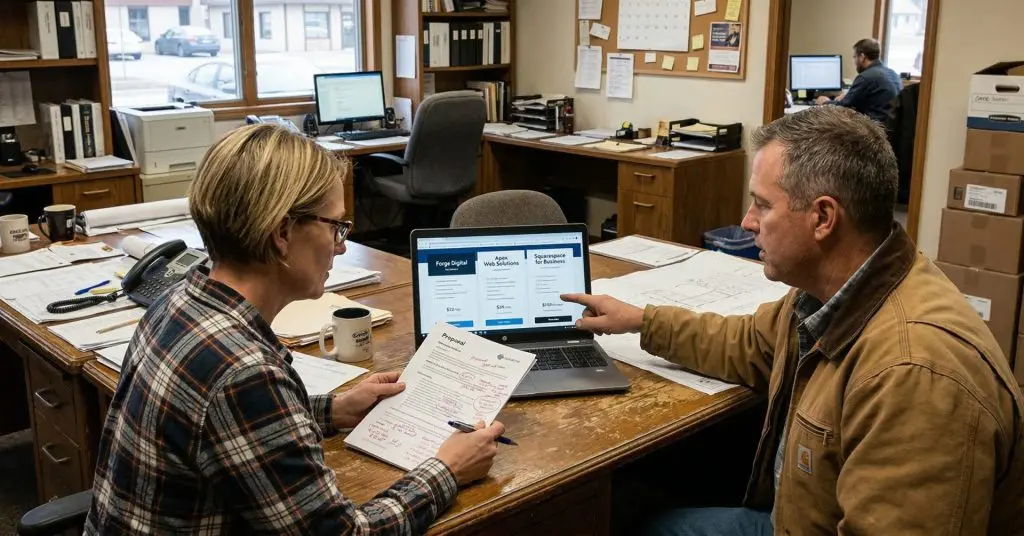
If you’ve been researching small business website cost, you’ve probably run into a pretty wide range of answers.
One article says you can get online for next to nothing. Another says a professional website can cost several thousand dollars or more.
That can feel frustrating, especially when you’re trying to make a smart decision for your business.
The truth is, both answers can be right.
The real question is not just, “How much does a website cost?” It’s, “What kind of website does my business need, and what am I actually paying for?”
In our experience, many professionally built small business website projects land in the $4,000 to $10,000 range. Simpler single-page style projects may start around $3,000, while more complex builds with large content needs, ecommerce, custom development, or third-party integrations can climb much higher. That lines up with broader industry guidance showing that website costs vary widely depending on scope, complexity, and who is building the site.
So let’s bring the elephant in the room out into the open and talk about what small businesses actually pay in 2026.
Table of Contents
The Short Answer: How Much Does a Small Business Website Cost?
A realistic small business website cost in 2026 depends on the type of solution you choose.
If you use a DIY website builder, your upfront cost may be low. If you hire a freelancer or agency, your investment is usually higher because you’re paying for more than software. You’re paying for strategy, planning, design, development, testing, launch support, and often ongoing guidance too. Public pricing guides consistently show DIY options at the low end, with professionally built small business websites often landing in the low thousands and moving into five figures as needs become more advanced.
Here’s a practical way to think about it:
| Website Type | Typical Cost Range | Best Fit For | What You’re Usually Paying For |
|---|---|---|---|
| DIY website builder | Low monthly cost to a few hundred up front | New ventures, side projects, temporary sites | Software, templates, and a self-serve setup |
| Budget template/freelancer site | Roughly $1,000–$4,000 | Businesses that need a simple online presence | A basic site with light customization |
| Professional small business website | Roughly $4,000–$10,000 | Businesses that want stronger credibility, better structure, and room to grow | Strategy, design, development, mobile optimization, forms, basic SEO setup, launch help |
| Strategic custom website | $10,000+ | Businesses with more content, functionality, integrations, or bigger growth goals | A more tailored site built to support performance and long-term flexibility |
That doesn’t mean every site fits neatly into a box. It just gives you a useful starting point.
Wondering where your project might land?
Every website is a little different. If you’d like help understanding what your business may actually need, we’d be happy to talk it through with you. We can help you sort out the scope, priorities, and budget range, then put together a real-life proposal based on your goals.
Why Website Prices Vary So Much
This is where a lot of business owners get tripped up.
At first glance, one website can look a lot like another. They both have photos, a menu, a contact form, and maybe a few service pages. So why does one quote come in at $1,500 and another at $8,000 or $12,000?
Because the difference usually isn’t just the design. It’s everything that goes into making that website useful.
In our experience, the biggest cost drivers are:
- Content scope
The more content that needs to be planned, written, organized, migrated, or refined, the more time and strategy the project takes. - Data migration
Moving content, files, blog posts, team pages, or product information from an old site into a new one can add a surprising amount of work. - Custom development
If the website needs features beyond standard layouts and forms, the build becomes more specialized. - Third-party integrations
Connecting your website to tools like a CRM, booking platform, payment system, or internal software often adds complexity. - Custom CMS setup
Your CMS, or content management system, is the behind-the-scenes area where you update the site. The more tailored that setup needs to be for your team, the more work goes into building it well. - Ecommerce functionality
Online selling often adds product setup, categories, filters, shipping logic, taxes, payment gateways, and other moving parts.
So when someone asks about the cost to build a small business website, the real answer is this: it depends on what the website needs to do.
What Most Business Owners Get Wrong About Web Design Pricing
One of the biggest misunderstandings we see is that people compare a professional website project to the monthly price of a DIY website platform.
That’s understandable. Those ads are everywhere. They make it sound like getting a website should be quick, cheap, and easy.
But those low monthly prices are usually pricing the software, not the thinking.
A professional website is not just a digital brochure or a pretty homepage. It’s often one of the most visible sales and credibility tools your business has.
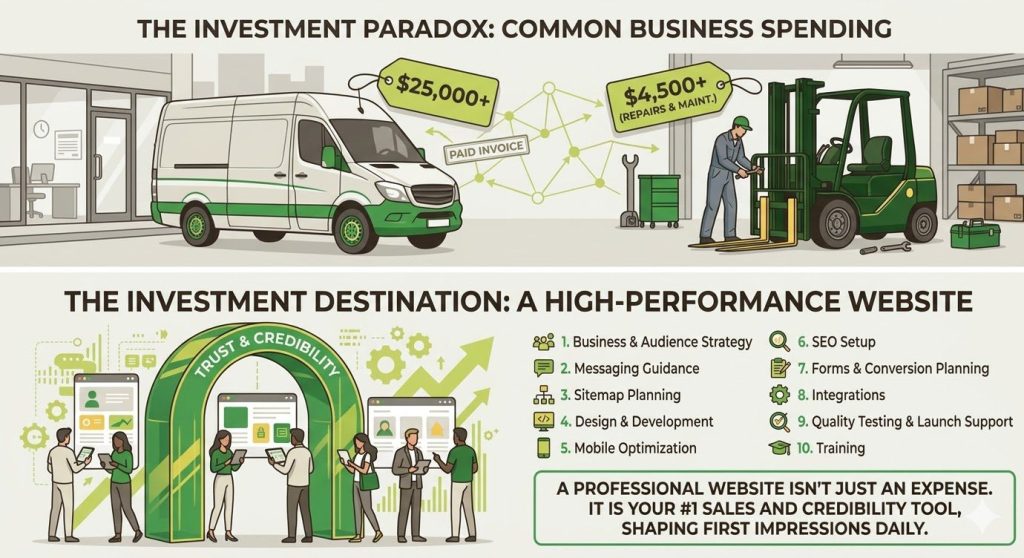
And when you hire a company to build it, you’re usually paying for things like:
- business and audience strategy
- messaging guidance
- sitemap planning
- design
- development
- mobile optimization
- SEO setup
- forms and conversion planning
- integrations
- quality testing
- launch support
- training
That’s a very different purchase than signing up for a template and trying to figure it out on your own.
Another thing many owners underestimate is the impact a website has on how their business is perceived. Businesses often think nothing of spending thousands on equipment, repairs, or software, but hesitate at a similar investment for a website that may be shaping first impressions every day.
A good website isn’t just there to exist. It’s there to support trust, reduce friction, and help your business win more often.
Cheap Website vs. Professional Website: What’s the Real Difference?
This is the part that matters most.
A cheap templated site can absolutely give you an online presence. In some cases, that may be enough for now.
But the biggest difference between a low-cost site and a professional site usually isn’t how it looks.
It’s how it performs.
A template-style website often asks you to fit your business into a pre-built system. A professional website starts by asking a different question:
What does your business need this website to do?
That one shift changes the whole project.
A lower-cost site often gives you:
- a basic presence
- a pre-defined layout
- lighter strategy
- less flexibility
- fewer opportunities to stand out
A professional website often gives you:
- a stronger credibility boost
- clearer paths for visitors to take action
- better content structure
- stronger SEO foundations
- more flexibility for future growth
- a site built around your goals instead of a template’s limitations
Templates can also feel generic. Visitors notice when a site looks like ten other sites they’ve seen before. That doesn’t always ruin the experience, but it can make it harder for your business to feel distinct.
A simple way to frame it is this:
Lower-cost websites can give you pages. A professional website is meant to give you a business tool.
Or to put it even more simply:
Do you need your website to just exist, or do you need it to perform?
Need a website that’s built to do more than just sit there?
If you’re looking for a website that supports credibility, lead generation, and long-term growth, we’d love to learn more about your business. We can help you think through what your site needs to do, what level of investment makes sense, and what a smart next step looks like.
What a Professional Website Usually Includes
When people look at small business website pricing, they often focus on the total before looking closely at what’s inside the project.
That’s a mistake.
A professional website proposal often includes work such as:
- discovery and planning
- page and content structure
- design direction
- custom or semi-custom design
- responsive development for mobile and desktop
- content management system setup
- forms and conversion points
- basic SEO setup
- redirect planning for redesigned sites
- testing and quality assurance
- launch support
- training or handoff guidance
That’s why two quotes can feel miles apart even if both promise “a new website.”
One may be priced to simply get something live. Another may be priced to create a stronger digital foundation your business can actually build on.
What About a Website Redesign Cost for Small Business?
If you already have a site, you may assume a redesign should be cheaper than starting from scratch.
Sometimes it is. But not always.
A redesign can include a lot of behind-the-scenes work, such as:
- cleaning up outdated content
- reorganizing confusing navigation
- preserving important rankings and URLs
- setting up redirects
- fixing technical issues from the old site
- reworking poor structure or messaging
In some cases, a redesign is really closer to a rebuild.
That’s why website redesign cost for small business can end up in the same general range as a new site, especially when the old site has years of clutter or technical baggage attached to it.
Ongoing Website Costs After Launch
A website is not one and done.
That’s another area where business owners are often surprised.
After launch, your small business website maintenance cost may include:
- domain renewal
- hosting
- premium plugins or apps
- software updates
- backups
- security monitoring
- support time
- content edits
- ongoing SEO or Local SEO work
Even simpler websites usually come with ongoing ownership costs. Public pricing guides regularly mention expenses like hosting, software subscriptions, and maintenance after launch.
That doesn’t mean something is wrong. It just means your website is a living business asset, not a one-time print piece.
A good website needs care if you want it to keep doing its job well.
How Much Should a Small Business Pay for a Website?
There’s no perfect number that fits every company.
But there is a better way to think about budget.
Don’t start with page count. Start with outcomes.
What does your website need to do for your business right now?
For many businesses, the website helps with at least a few of these:
- building credibility
- answering common questions
- helping prospects understand services
- generating leads
- supporting sales conversations
- saving internal time
- connecting with other systems
That means a strong website may impact both revenue and efficiency.
A common mistake we see is budgeting based on pages instead of goals. A five-page site can be simple and inexpensive. It can also be strategic, persuasive, and carefully built to support conversion. The number of pages alone doesn’t tell the whole story.
A smarter question is:
What are the stakes if this website underperforms?
If the site is important to credibility, lead flow, or operations, underinvesting can end up costing more than expected.
Is a $4,000–$10,000 Website Worth It?
For many established small businesses, yes.
Not because spending more is always better, but because the right website can start paying its way back in multiple ways.
A strong website can help you:
- look more credible
- generate better-fit leads
- support your sales process
- answer common questions faster
- reduce friction for customers
- save time for your team
- create a better foundation for SEO and long-term growth
That doesn’t mean every business needs a bigger project. Some businesses really do just need a simpler site for now.
But if your website plays a meaningful role in how customers find you, evaluate you, and contact you, it makes sense to view it as more than a checkbox item.
How to Tell if a Website Quote Is Fair
If you’re comparing options, don’t just compare bottom-line price.
Compare what’s included.
Ask questions like:
- What strategy work is part of the project?
- Is content planning or copywriting included?
- What SEO setup is included?
- Are redirects and launch details handled?
- Is the site mobile-optimized?
- Are integrations part of the price?
- What kind of CMS setup is included?
- Is training or support included after launch?
A fair quote should feel clear. You should understand what you’re buying and why it costs what it costs.
If a proposal feels vague or glosses over important pieces, that’s worth pausing on.
Bottom Line
If you remember one thing from this article, let it be this:
Small business website cost is not really about pages. It’s about purpose.
Yes, there are low-cost ways to get online. And yes, those options can make sense in the right situation.
But when your business needs a website that builds trust, supports growth, improves the customer experience, and gives your team a stronger digital foundation, the investment usually looks different.
In our experience, many professionally built small business websites land in the $4,000 to $10,000 range, with simpler projects starting lower and more advanced builds climbing higher based on complexity, integrations, and business goals. That fits the broader market too, where current pricing guidance shows a wide range depending on the approach and requirements.
The goal isn’t to spend more than you need.
It’s to invest wisely in a website that helps your business grow with stronger roots.
Want a real proposal instead of a rough guess?
If you’re ready to talk through your website goals, we’d be glad to help. At CYBERsprout, we partner with businesses to build websites that support credibility, improve performance, and create room for growth. Reach out and we can put together a proposal based on your real needs, not a generic template.
FAQs
How much does a small business website cost in 2026?
It depends on the type of solution. DIY options can start low, while professionally built websites often land in the low thousands to mid-thousands or more depending on content scope, functionality, and support needs.
Why are some website quotes so much higher than others?
Because they often include different levels of strategy, content planning, SEO setup, design, development, integrations, testing, and launch support. Two websites can look similar on the surface but involve very different amounts of work.
Is it better to use a website builder or hire a company?
That depends on your goals. A builder may be enough for a simple online presence. Hiring a company usually makes more sense when the website needs to support credibility, lead generation, SEO, or more advanced functionality.
What ongoing website costs should I expect?
Common ongoing costs include hosting, domain renewal, plugins or apps, updates, backups, security, and support. Most current pricing guides mention ongoing costs after launch, even for relatively simple sites.
Does SEO make website design cost more?
It can. SEO, or search engine optimization, helps search engines understand your content and show it to the right people. Basic SEO setup may be included in a project, while deeper ongoing SEO work is often separate.
References and Further Reading
How Much Does A Website Cost? (2026 Guide)
https://www.forbes.com/advisor/business/software/how-much-does-a-website-cost/
How Much Does a Small Business Website Cost?
https://elementor.com/blog/how-much-does-a-small-business-website-cost/
Creating Helpful, Reliable, People-First Content
https://developers.google.com/search/docs/fundamentals/creating-helpful-content/
SEO Starter Guide
https://developers.google.com/search/docs/fundamentals/seo-starter-guide/

